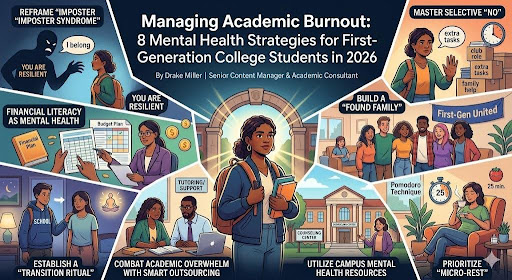
Managing Academic Burnout: 8 Mental Health Strategies for First-Generation College Students in 2026
By Drake Miller – Senior Content Manager & Academic Consultant
For many, college is a period of excitement and growth. But for first-generation college students—those who are the first in their families to pursue a four-year degree—the journey is often paved with a unique set of pressures. Between navigating complex financial aid systems, balancing family expectations, and striving for academic excellence, the risk of “hitting a wall” is significantly higher than that of their legacy peers.
Academic burnout isn’t just about being tired; it’s a state of physical, emotional, and mental exhaustion caused by prolonged stress. When you are the first to blaze the trail, the stakes feel higher, making burnout almost feel like an inevitable rite of passage. However, it doesn’t have to be. Whether you are tackling complex coding projects and need Android assignment help or require guidance on general coursework, knowing when to seek support is vital for long-term success.
Understanding the “First-Gen” Burnout Phenomenon
Before diving into strategies, it is essential to recognize why first-generation students are particularly susceptible to burnout. Unlike their peers whose parents attended college, first-gen students often lack a “roadmap.” This absence of inherited institutional knowledge means that tasks like deciphering a syllabus, applying for FAFSA, or attending office hours can feel like learning a second language.
Furthermore, many first-gen students carry the weight of their family’s hopes on their shoulders. This can lead to a “failure is not an option” mentality. In the competitive landscape of USA search for academic success, this internal pressure often manifests as chronic over-achievement, where the student feels they must prove they belong in every single lecture hall. During these high-pressure moments, seeking support from a professional assignment writer or opting for assignment help at Myassignmenthelp.com can provide the necessary breathing room to focus on mental well-being without compromising grades.
The Warning Signs: How to Know if You’re Burnt Out
Recognizing burnout is the first step toward recovery. In the high-pressure environment of US higher education, these signs are often dismissed as “grinding,” but they are actually red flags:
- Chronic Fatigue: You feel exhausted even after a full night’s sleep.
- Alienation from Activities: You no longer find joy in your classes, social life, or hobbies.
- Reduced Cognitive Performance: You’re struggling to concentrate, and your grades are slipping despite spending more time “studying.” For students in technical fields, this often looks like hitting a wall with complex coursework; in such cases, seeking specialized programming assignment help can provide the breathing room needed to recover.
- Physical Symptoms: Frequent headaches, stomach issues, or a weakened immune system.
1. Reframe the “Imposter Syndrome”
Many first-gen students struggle with Imposter Syndrome—the nagging feeling that you don’t belong in higher education or that you only got in by luck. This mental loop is a major driver of burnout because it forces you to work twice as hard to “prove” your worth.
The Strategy: Acknowledge that your perspective is a strength, not a deficit. You bring a unique resilience and world-view to your campus. When the “imposter” voice speaks up, remind yourself of the concrete hurdles you’ve already cleared to get here. Shifting from a deficit mindset to an asset-based mindset is the most powerful tool a student has.
2. Master the Art of Selective Saying “No”
First-generation students often feel a deep sense of responsibility to their families. You might feel obligated to go home every weekend to help with household management or younger siblings, or feel guilty for missing a family event.
The Strategy: Boundaries are a form of self-care. It is okay to tell your family that you need a weekend to focus on a heavy mid-term project. It is okay to decline a club leadership role if your plate is full. Use professional resources like MyAssignmentHelp.com when the workload becomes physically impossible to manage alone. Delegating and seeking support is a sign of a smart, strategic student, not a struggling one.
3. Build a “Found Family” on Campus
One of the hardest parts of being a first-gen student is the “relatability gap.” When you go home, your family may not understand the specific stress of a 20-page research paper or a complex lab report.
The Strategy: Seek out First-Gen Student Unions or bridge programs specifically designed for students like you. Surrounding yourself with peers who share your background provides a safety net. When you have a group that understands the specific stress of explaining a “GPA” or a “major” to a parent who didn’t go to college, the emotional burden becomes much lighter.
4. Prioritize “Micro-Rest” Over “Macro-Rest”
Most students think they need a week-long vacation to recover from burnout. In reality, burnout is prevented through daily maintenance.
The Strategy: Implement “Micro-Rest.” This involves 5 to 10-minute breaks every hour where you completely disconnect from screens. Practice the 20-20-20 rule: every 20 minutes, look at something 20 feet away for 20 seconds. Additionally, adopt the Pomodoro Technique—working in 25-minute sprints followed by short breaks—to maintain cognitive endurance without hitting the wall.
5. Utilize Campus Mental Health Resources (They are Pre-Paid!)
Many first-gen students hesitate to use campus counseling centers because of cultural stigmas surrounding mental health or a fear that they are “taking resources” from others.
The Strategy: Remember that your tuition and fees likely already cover these services. Think of the counseling center as a gym for your brain. Whether it’s one-on-one therapy or stress-management workshops, these professionals are trained to help you navigate the specific transition of being a first-gen student in the US.
6. Combat Academic Overwhelm with Smart Outsourcing
High school students transitioning to college often find the sheer volume of writing assignments overwhelming. The “all-nighter” culture is a direct path to burnout and long-term health issues.
The Strategy: Learn to differentiate between “busy work” and “deep learning.” If you find yourself stuck on a complex research paper or a technical essay that is paralyzing your progress, don’t let it freeze you for days. Seeking professional guidance or tutoring can help break the cycle of procrastination and anxiety. Using an academic support service can provide the clarity and structure needed to get back on track without sacrificing your sleep or sanity.
7. Establish a “Transition Ritual”
For many first-gen students, the line between “school” and “home” is blurred, especially if you are a commuter or working a job on the side. This prevents the brain from ever entering a “rest and digest” state.
The Strategy: Create a physical ritual that signals the end of your “academic day.” This could be changing your clothes as soon as you get home, listening to a specific podcast on your commute, or a five-minute meditation. This tells your nervous system that it is safe to stop “performing” and start recovering.
8. Financial Literacy as Mental Health
In the USA, money is one of the top stressors for first-gen students. The fear of debt, hidden fees, or running out of funds can cause constant, low-level cortisol spikes that lead directly to burnout.
The Strategy: Schedule a meeting with a financial aid advisor once a semester—not just when there’s a crisis. Understanding your bills, grants, and work-study options removes the “fear of the unknown,” which is a significant contributor to mental fatigue.
Expert Commentary: The E-E-A-T Perspective
“In my years as an Academic Consultant, I have observed that the students who succeed long-term are not those who work the most hours, but those who manage their energy most effectively. For first-generation students, success is as much about navigating the emotional landscape of higher education as it is about mastering the curriculum. Integrating support systems early is the most Authoritative step a student can take toward their degree.” — Drake Miller
Frequently Asked Questions
Q.1 What are the most common causes of burnout for first-generation students?
For first-generation students, burnout is often driven by a “double burden”: managing rigorous academic expectations while simultaneously navigating a university system that feels culturally unfamiliar. Lack of legacy knowledge, financial pressure, and the internal need to “repay” their family’s sacrifices through perfectionism are primary drivers.
Q.2 How can high school seniors prepare for the mental health challenges of college?
Preparation starts with building a “support mindset” before setting foot on campus. High school seniors should research the specific mental health and tutoring resources available at their target universities. Normalizing the act of asking for help—whether through campus counseling or services like MyAssignmentHelp.com—is the best way to prevent the transition shock that leads to early burnout.
Q.3 Does seeking academic help count as “cheating” or a sign of failure?
Absolutely not. In the US higher education system, “smart students” are defined by their ability to manage resources. Utilizing tutoring, writing centers, or professional academic consultants is a standard practice among top-tier students. It is a strategic move to ensure you are focusing your mental energy on deep learning rather than administrative or “busy work” overwhelm.
Q.4 How do I explain my academic burnout to parents who didn’t attend college?
The “relatability gap” can be bridged by using analogies. Explain that college is like a high-intensity job where the “overtime” is mental rather than physical. Share that just as a physical injury needs rest to heal, a “mental fatigue” from constant studying needs strategic breaks and professional tools to ensure you can reach the finish line of graduation.
About the Author: Drake Miller
Drake Miller is a senior content manager and academic consultant with over a decade of experience in the educational technology and student success sectors. As a specialist in higher education strategy, Drake focuses on the ethical integration of AI in academia, digital literacy, and productivity frameworks for university students. Having worked extensively with students across the USA, UK, and Australia, he provides authoritative insights into overcoming systemic academic barriers.
Stay in touch to get more updates & news on Fappening Blog!