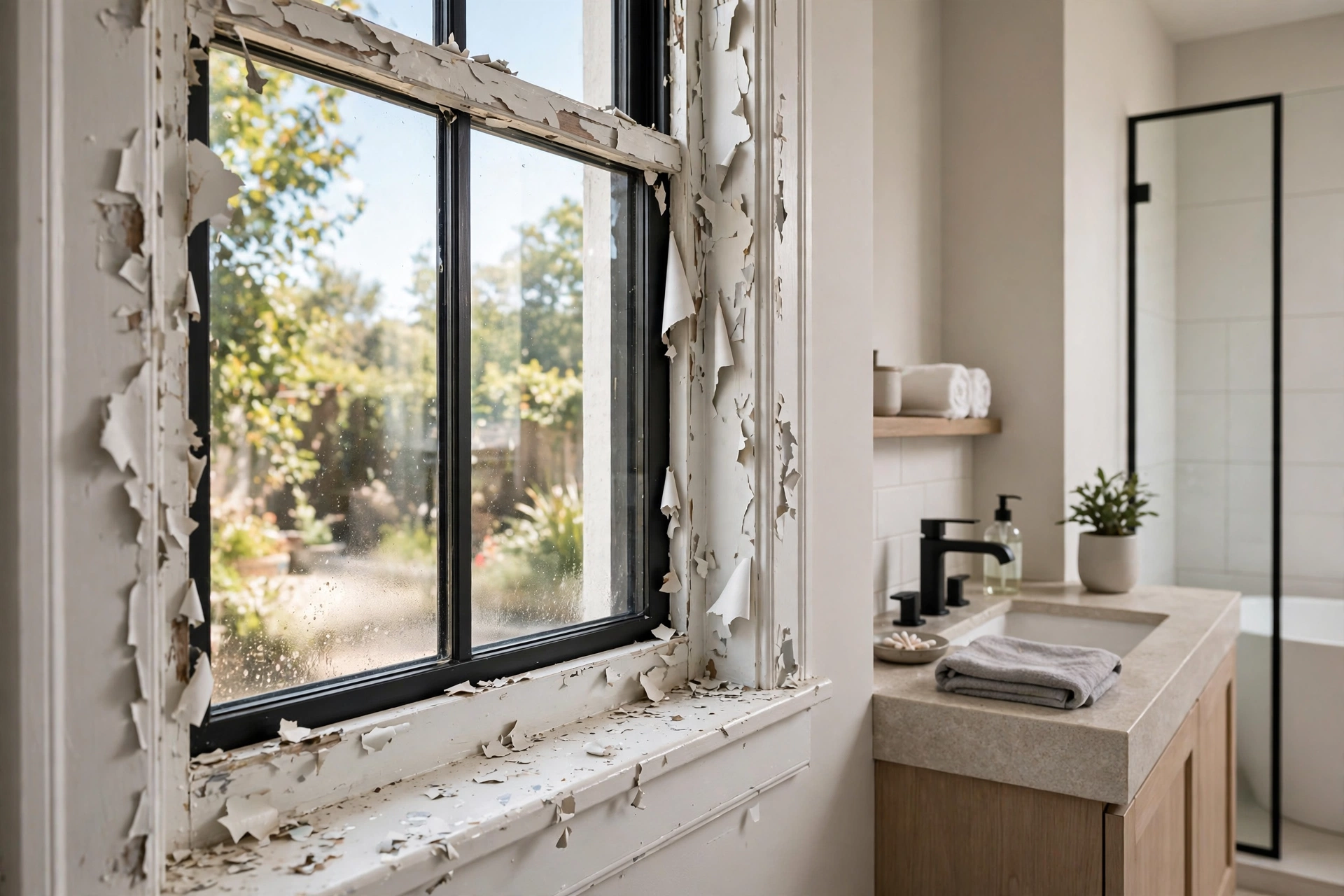
Why Does Fresh Paint Peel Around Bathroom Windows Despite Using Moisture-Resistant Products?
You bought paint marked moisture-resistant, brushed it around the bathroom window, and soon the fresh coat is curling, bubbling, or lifting from the frame. The paint is rarely at fault: it is being asked to do a job it was never designed to do alone.
A bathroom window sits at the coldest spot in the steamiest room in the house and collects running water every time someone showers. When paint peels there, water is almost always reaching it from behind or beneath. Until that water is stopped, every new coat will fail in the same place.
The Short Answer: Water Is Attacking Your Bathroom Window Paint From Behind
Moisture-resistant paint resists water landing on its finished face. It is not a waterproof seal, and it cannot hold on when water gets underneath it. Around a bathroom window, water reaches the back of the paint film when steam condenses on cold glass and runs down onto the sill, when cracked exterior caulk lets rain in around the frame, when a failed window seal lets moisture into the wall, or when the wood was damp when painted. Once water sits between paint and surface, adhesion breaks down, the film blisters, and then it peels.
So the fix is never just another coat: find the water, stop it, dry everything fully, prepare the surface, and only then repaint with the right primer and topcoat. Skip any step and the peeling returns, usually faster than before.
Why a Bathroom Window Collects More Water Than Any Other Wall in the Room
During a hot shower, warm moist air seeks the coldest surface it can find, and glass is almost always that surface, especially in winter or with single glazing or a metal frame. Moisture condenses on the pane, runs down, pools along the bottom of the frame, and soaks into the sill, trim joints, and the wall below. Wood then swells and shrinks as it wets and dries, opening hairline cracks at joints that admit the next round of water. Because a bathroom window is often kept closed for privacy, damp air also lingers there longer than elsewhere.
Notice the seasonal pattern. Peeling worst in winter points to condensation, because cold glass meets warm steamy air most dramatically then. Peeling worst after heavy rain, or a wall that stays damp long after the bathroom has dried, points outside instead: rainwater entering through failed caulk, flashing, or a damaged frame.
Reading the Peel: What the Damage Around Your Window Is Telling You
Before you scrape anything, read the failure, because the way paint peels points to different causes. A flake lifting in a large, flexible sheet with a smooth, glossy back usually means the new paint never bonded to the surface beneath it. Small bubbles breaking open to reveal damp or soft material point to moisture pushing outward from inside the wall. Peeling confined to the sill and lower frame, while the top of the window looks fine, almost always means water pooling there or running down the glass. Soft or crumbly wood, or powdery plaster, means moisture has soaked in and the material needs repair first; a shiny old coat underneath means an adhesion problem.
Six Ways Water Gets Behind a Bathroom Window Coating
Most peeling bathroom windows suffer from more than one of these at once.
- 1. Condensation running down the glass. The most common cause: steam condenses on the cold pane, runs down, and sits on the sill and in frame joints. Without a fan venting outside, that water gets hours to soak in daily.
- 2. Failed exterior caulk and flashing. Sealant around the outside of the frame hardens, shrinks, and cracks with age and weather. Once a gap opens, rainwater tracks into the wall and attacks the interior paint from behind.
- 3. A broken window seal or damaged frame. Failed glazing seals let moisture into the frame, while rotted timber holds water like a sponge. Paint over damaged wood is only a skin over a wet core, and it lifts as soon as the wood swells.
- 4. Painting over a damp or dirty surface. Bathroom frames collect soap film, cleaning residue, and grease, which act as a barrier between paint and surface. Paint over dampness bonds to the moisture, not to the wood or plaster.
- 5. Skipped primer, or the wrong primer. Moisture-resistant topcoats are only half of a paint system. Without a primer that seals and grips, the topcoat has nothing reliable to hold onto, especially on bare wood, patched plaster, or old gloss paint.
- 6. Recoating too soon, or coating too thickly. Paint that feels dry is not yet cured, and in a humid bathroom curing takes longer than the label's ideal conditions suggest. A coat applied too early, or one heavy coat that skins over while soft underneath, traps moisture and blisters weeks later.
A Window-First Repair Sequence That Actually Holds
The order matters more than the brand. Do not move on until each step is complete.
Find the water first. After rain or a long hot shower, inspect the outside of the window for cracked caulk, gaps, and damaged flashing. Inside, check whether the wall is damp, whether the sill pools water, and whether the fan vents outdoors. Fix leaks and ventilation before touching a scraper.
Let everything dry completely. The wood and plaster should feel dry and stay dry through several showers before you paint.
Remove all loose paint. Scrape back to firmly bonded paint, feather the edges with sandpaper so the repair blends invisibly, and sand glossy old paint dull so the new coat can grip. Vacuum and wipe away all dust.
Clean the surface properly. Wash the frame and wall with mild detergent to remove soap film and grease, rinse, and let it dry again. If mildew is present, clean it with a suitable remover; never paint over active mildew.
Repair the substrate. Fill cracks and gaps in frame joints with a paintable, flexible sealant made for wet areas, and replace any wood or plaster that is soft, crumbly, or rotted. A paint system cannot rescue damaged material.
Prime with the right product. Use a bonding primer over glossy old paint, a stain-blocking primer over water stains, and a moisture-resistant primer on bare wood and patched plaster. Allow the full label drying time, longer in cold or humid conditions.
Apply two thin coats of bathroom-rated paint. A satin or semi-gloss finish cures to a harder, less porous film than flat paint, resists moisture, and wipes clean. Two thin coats beat one thick coat every time. Then let the paint cure fully before heavy steam exposure.
Keep the fan running during and for at least 20 to 30 minutes after every shower, not just while you paint. A fan too small for the room, or one venting into the ceiling void, will defeat even a perfect paint job.
Choosing a Coating System That Survives a Steamy Bathroom Window
The term moisture-resistant is not a single standard. Match the primer to the surface you have: on old timber layered with glossy paint, a bonding primer matters more than the topcoat brand, and below a stained window, a stain-blocking primer matters more than either.
When you shop, look for bathroom or kitchen and bath on the label, a satin or semi-gloss sheen, and mildew resistance. Follow the label's recoat and cure times, adding extra drying time in a humid bathroom rather than less.
What a Peeling Bathroom Window Frame Can Cost to Put Right
Costs vary by region and by how much damage the water has already done, so treat these figures as rough estimates only. A straightforward DIY repair of one window, meaning caulk, sandpaper, a litre of primer, and a litre of bathroom-rated paint, typically runs 30 to 80 in local currency for materials. Replacing an exhaust fan with one correctly sized and vented outdoors commonly falls between 150 and 500 including parts and labour, depending on ducting and access. If the frame is rotted, or wall material around the window must be replaced, estimates of 300 to 1,000 or more for a single window are not unusual, still far cheaper than repainting the same window every few months.
When a Peeling Bathroom Window Needs a Pro, Not Another Coat
Call a qualified professional rather than repainting if the wall stays damp for days after the bathroom has dried, or paint peels again within weeks of a careful repaint, since that suggests a leak inside the wall or a failed flashing that needs tracing. Soft, spongy, or visibly rotted framing, or plaster that crumbles when touched, needs damaged material cut out and replaced, not covered. A persistent musty smell, or mould over a large area, should also be assessed professionally.
Safety deserves a direct note. Homes built before lead paint was banned may have lead-based paint on old window frames, and sanding or scraping it without precautions is a serious health hazard. If your home predates the late 1970s, or you are unsure, have the paint tested before disturbing it and use a certified lead-safe contractor if lead is present. Small mould spots can be cleaned carefully with gloves, eye protection, and a mask, but widespread growth behind paint or inside walls is a professional job, as is work at height or opening up a wall to find a leak.
Bathroom Window Paint Peeling Questions Homeowners Keep Asking
Can I just paint over peeling paint around my bathroom window with a stronger product?
No. Primer and paint only bond to a sound, clean, dry surface. Painting over loose or blistered paint traps the failing layer underneath, and the new coat peels along with it. Scrape back to firmly bonded paint, feather the edges, clean, prime, and then repaint.
Why does the paint peel around the bathroom window but nowhere else in the room?
Because the window is the coldest surface in the room and the most exposed to running water. Condensation forms on the glass first, runs down onto the sill and trim, and soaks into joints, while the rest of the wall stays warmer and drier.
How long should I wait before using the shower after repainting a bathroom window?
Follow the label's cure time, adding extra time in cold or humid conditions. Avoid heavy steam on fresh paint for at least 24 to 48 hours, keeping the fan running. Paint that feels dry is not yet fully cured.
Is peeling paint around a bathroom window a sign of a serious leak?
Not always, but it can be. Condensation alone causes most cases, especially when peeling is worst in winter and confined to the sill and lower frame. Peeling that persists in summer, returns within weeks of a careful repaint, or comes with damp walls or a musty smell points more strongly to a leak.
Should I replace the window instead of repainting it?
Repainting is enough when the frame and wall are solid, the exterior seal can be renewed, and ventilation can be fixed. Replacement becomes sensible when the frame is rotted, the glazing seal has failed, or the window no longer closes properly.
Your Next Step Before the Next Coat Goes On
Fresh paint peeling around a bathroom window is frustrating precisely because you chose the right product and still got the wrong result. But the paint was never the whole answer. The window fails because water reaches it from behind, through condensation, failed exterior seals, damaged timber, or a damp surface painted too soon. Fix the water first, let everything dry, prepare the surface properly, prime for the surface you actually have, and finish with two thin coats of a bathroom-rated satin or semi-gloss. Do it in that order, and the next coat will be the last one you need for years. Afterwards, run the fan during and after every shower and wipe winter condensation from the sill. Before you buy another tin, inspect the outside of the window and check the fan, because the real repair starts with the water, not the paint.